Showing posts with label designers. Show all posts

Friday, April 18, 2014

FO Friday: Royal Tenor Cami

As promised, I'm gonna show you what I made with that purple linen while I was away, my version of the Razor Cami.  It's pretty.  It fits.  It... can't be worn on its own because it's rather see-through.  But I love it, and I hope you do too.


Just as I expected, my slightly large gauge resulted in a S/M size, just right for me.  The straps might be a little bit long, but I prefer to have extra room in the armpits, and since I'll have to wear another cami under this one anyhow that's even better.  

Props to the designer, Katie Marcus.  Her pattern was easy to follow, and I'll never be able to express my full gratitude for designers who give their work away for free.  

The best part about this FO is that it has really strong memories attached to it.  The lace is knit together with the ringing chords of the choruses, the sweet sound of the quartets, the laughter that accompanied the Open Division contestants, and all the excitement of taking the stage for the first time.  Every time I wear this cami, I'm going to remember the people I met, the songs we sang, the late nights and friendship and fun.  

Wednesday, April 2, 2014

Color, Color Everywhere

The other class I took at Vogue Knitting Live was called Slip Sliding Away, and it centered around using slipped stitches to create interesting texture and color combinations.  Melissa Leapman, a famous designer, taught the class in her characteristically laid back, slightly funny, almost meditative way.

Now, this class came with homework.  That's right, homework.  I felt like I was back in college.  Even worse, the homework was boring.  We had to knit 5 test swatches, each a different color, of 21-25 stitches (respectively), in K1P1 ribbing for one inch.  Uggh, so boring.  But I faithfully knit the swatches in the ugliest colors in my scraps bin because those are the scraps with the most yardage.  Look what they became:

Sorry for your eyeballs.


The first swatch played with texture.  Each row moves the slipped stitch over just a tad so that these zigzag patterns emerge in the fabric.

Oooh!


The second swatch is also a texture piece, with elongated stitches creating little boxes that stick up slightly.  I'd love to do a baby blanket with this stitch pattern.

Aaahh!


Then we started to get into playing with color.  Swatch three used three colors, but only one color was worked with at a time.  It made a sort of chevron pattern that looks like a castle to me, but it was way easier than actual chevron with much less counting involved.  I might use this technique to make a hat.

Wow!


Next is this sort of dragon scale stitch.  It doesn't look so great in the swatch, but the samples that the teacher brought were fantastic!

Mmmmmm!


The last stitch we practiced is definitely not something I'm likely to use.  It has cables between columns of colorwork.  Obviously, it's awful with the colors I used (thank you, scrap bin), but even the samples Leapman brought didn't really wow me.  It might be good to use in a man's sweater pattern, but even then it's a bit too much work for the result.

...eeeww...

I would definitely recommend this class to anyone who wants to learn these techniques.  Even if you think you could easily eyeball these swatches and reproduce the stitches, it's still worth your time and money because of how incredibly inspiring it is.  She blew our minds with some of the stitches she's come up with, some of the different ways we can play with color, and it's all so much easier than you'd imagine.  

If you're interested in learning more about these techniques, I would highly suggest Leapman's books, Color Knitting the Easy Way and The Knit Stitch Pattern Handbook, which includes 300 (three-freaking-hundred!) different stitches you can make with knitting.  

Monday, March 31, 2014

Blissful Brioche

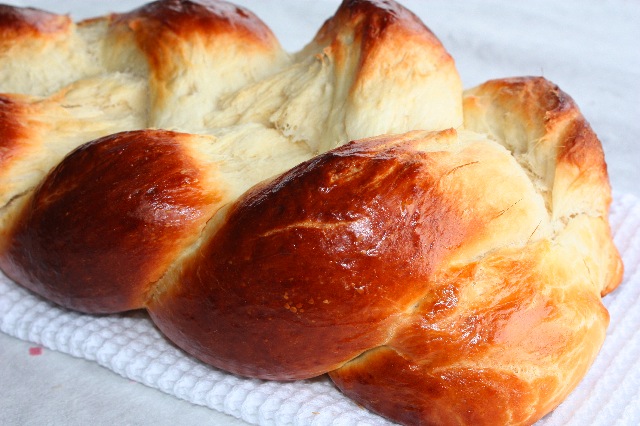
Nope, not the bread, though you will wreck your diet just by looking at this Google search.

Please, just a taste?

Brioche knitting is a technique that creates a squishy double-sided fabric.  I've dabbled in it before to create a simple infinity scarf with a variegated yarn and a more complex cabled scarf based off of the Reversible Cabled Brioche Stitch Scarf pattern by Saralyn Harvey.  Brioche has its own rhythm, slightly different from the flow of regular knitting, and I found it very therapeutic.

But I wanted to step it up a knotch.  I kept seeing all these patterns for brioche knitting in two colors, like this wonderful hat:

Photo courtesy of the Ravelry 

That hat, the Pinwheel Beret by Nancy Marchant, blew me away.  It's so pretty, and the color combinations are endless, and I WANT one!  But the pattern is almost written in a different language.  I had no idea what a "bark" was or how to execute a "burp," so I thought this technique was beyond my reach.

Until, of course, I signed up for a Two-Color Brioche class as Vogue Knitting Live.  And who do you think taught it?  The very same designer, Nancy Marchant!  

I have to admit, I was a little bit disappointed with the class.  It cost a lot of money, and we spent the vast majority of the class trying to learn what she calls the "Italian Cast On," which was not an essential skill but a nice-to-know.  It felt like a waste of time to learn that one picky little trick instead of what we were actually supposed to be focusing on.  

Nevertheless, I did learn what a burp is (brioche purl stitch), how to read a brioche pattern, and how to work with two colors in this fabulous stitch.  Check out my perfectly imperfect beginner's swatch:

Isn't she lovely?
If you look closely, you can see my mangled stitches on the third or so row up.  Other than that and the poor color choices (they were just a couple scrap balls I had leftover), I think it turned out marvelously!  I'll put that in my success column.

If you want to learn more about this brilliant technique, check out Nancy's website, www.briochestitch.com.  She has tutorials and explanations for working the stitch with one or two colors, all the accompanying tips and tricks, and free patterns!  Her book, Knitting Brioche, is also beautiful, and I'm dying to get my hands on it, especially now that I know what I'm doing.  

Thursday, March 6, 2014

A Knitter's Approach to Copyright

Since I have only designed one thing in my knitting career, 99.9% of the items I knit are from another designer's pattern.  They've come from magazines, books, Ravelry, other blogs, Reddit, and pamphlets.  But regardless of where they're published, most of the patterns I use have a copyright notice that I have to pay attention to, especially because I intend to sell a lot of my knit goods.  So what do knitters need to know about copyrights?

Knitty.com has a great laymen's guide to copyright for knitters that explains the basics.  Knitters have to be aware that copyright can apply to an entire written pattern including charts and instructions, stitch patterns, photos in a pattern, and knit goods that come from patterns.  Knitty's conclusion is that it's best to ask the copyright owner if you have any question about your usage.

A lot of knitters disagree on the matter.  Copyright can be really hard to enforce, especially when it comes to the gray area surrounding the sale of knit goods.  A designer would have to be particularly litigious, really adamant about the use of their patterns, for a knitter to see any consequences from infringement.  As such, a lot of knitters don't worry about copyright issues.

Honestly, I wish I could be one of those knitters.  There are a lot of pretty patterns out there that I want to make and would like to sell, but I hate the idea of stepping on another crafter's toes.  These designers have been kind enough to put their work out into the world (many of them for free), and I want to reward their kindness by actually paying attention to their wishes.  So I look for a copyright notice on every pattern I consider.  I think of copyright notices in three categories that I call restrictive, optional, and permissive.

Restrictive copyright notices retain all rights for the designer.  These designers are clear about their work being for personal use only.  I would not use patterns with these copyright notices for selling items:

  • Copyright 2011.  All rights reserved.
  • For personal, non-commercial use only.
Optional copyright notices are a little less definite.  You may or may not be allowed to use that pattern, and the only way to find out is to ask.  If I see something like this, I'll contact the designer for permission:
  • Pattern and images © 2013
  • No copyright notice
Permissive copyright notices, god bless them, are when designers specifically say that they don't mind their work being used for commercial purposes:
  • Written pattern copyright 2012. Please do not reprint or repost this pattern, but please feel free to link to this page to share this pattern with others. You are welcome to sell items made from this pattern, but please link back to [the designer] with credit for the design on the listing or tag.
  • "Please link this pattern to your listing if you do plan to sell from it."
Most often, permissive copyrights include a little request from the designer that you link back to their pattern so that they get credit for the design.  That's the type of copyright notice I chose for my Refreeze pattern because I want credit for the design but don't mind if people sell their items.  

There's a lot of wiggle room in knitting copyright, a lot of gray area to sludge through.  I just try to do what feels right, give credit where credit is due, and knit the things that make me happy.